

Sustainability Isn’t a Product - It’s How You Work
Many organisations want to make sustainable choices, but the conversation often starts in the wrong place: “Which eco product should we use?”
In reality, sustainability isn’t a product. It’s not a substrate, or a coating, or a label you apply to a job.
True sustainability comes from how the work is done, not what it’s called.
And when you look at visual communications through that lens, the impact becomes practical, manageable and real - not performative.
Here are the behaviours that actually make the difference.
1. Better Materials, Chosen With Purpose
Most waste in visual communication isn’t created at the end of a project - it’s created at the beginning, when materials are chosen without considering lifespan, finish, removal, recyclability, or environmental conditions.
Sustainable material decisions are rarely glamorous. They look like:
- choosing PVC-free substrates when a recyclable alternative performs just as well
- using eco-certified papers and fabrics
- selecting solvent-free or low-impact inks
- recommending materials that survive the intended lifespan so replacements aren’t required
- avoiding multi-piece solutions when a single-piece print reduces waste and joins
A good example is a recent heritage installation where a 5m × 3m timeline wall was produced on an eco greyback fabric, printed as a single piece. This cut down on joins, reduced waste, and delivered a cleaner, longer-lasting finish - all through one sensible material decision.
This is sustainability at its most effective: thoughtful, quiet, and built into the work.
2. Designing for Longevity, Not Disposal
Short-term thinking creates waste.
Well-designed environments - even temporary ones - avoid it.
Longevity doesn’t always mean “permanent.” It means fit for purpose:
- indoor graphics that don’t fade under harsh lighting
- wall coverings that stay stable and safe for years
- installations built around existing fixtures
- graphics designed to be removed cleanly without damaging surfaces
- engineered systems that survive their intended environment, whether a retail space, airport, or visitor attraction
Permanent spaces illustrate this best.
The Sound & Vision Gallery at the National Science & Media Museum, for example, was designed and built to last more than 25 years. That kind of lifespan is only possible when material selection, finishes, fixings and build methods are considered from the outset.
Longevity isn’t about spending more.
It’s about replacing less.
3. Production That Reduces Waste by Default
Production is often viewed as the “middle step” - but it’s where consistency and efficiency protect both the environment and your budget.
Sustainable production looks like:
- colour management that avoids reprints
- print profiles that reduce ink waste
- machines calibrated to minimise scrap
- producing work at the closest facility to reduce transport miles
- bulk packing jobs to avoid multiple courier runs
- quality checks that prevent problems downstream
Large, multi-site projects - like the London Marathon or UEFA Women’s EURO - demonstrate this well. When planning, proofing and production are tightly controlled, assets install correctly the first time.
No reprints.
No unnecessary vehicle movements.
No avoidable waste.
Accuracy is sustainability too.
4. Installation and Logistics: The Hidden Sustainability Factor
Installation is where sustainability quietly succeeds or fails.
Most environmental impact on fast-moving projects doesn’t come from materials - it comes from:
- multiple site visits
- unexpected rework
- incorrect measurements
- inefficient logistics
- repeated installations due to low-quality fixings
- return trips for patch repairs
Sustainable installation looks like:
- proper site surveys
- experienced installers who get it right first time
- safe working processes that reduce waste and damage
- coordinated logistics across all crews
- removing graphics carefully so they can be recycled, not skipped
In large-scale temporary environments - for example, tournament branding requiring thousands of square metres of graphics - efficient deployment is one of the biggest sustainability wins. One coordinated operation avoids the multi-trip inefficiencies that create unnecessary carbon impact.
Good installation prevents waste long before recycling comes into the picture.
5. Circularity and Reuse Built Into the System
Circularity doesn’t have to be complicated.
Sometimes it’s as simple as choosing systems designed to stay in circulation.
Modular exhibition structures are a good example of practical circular design.
The framework stays in use for years; only the interchangeable graphic skins change.
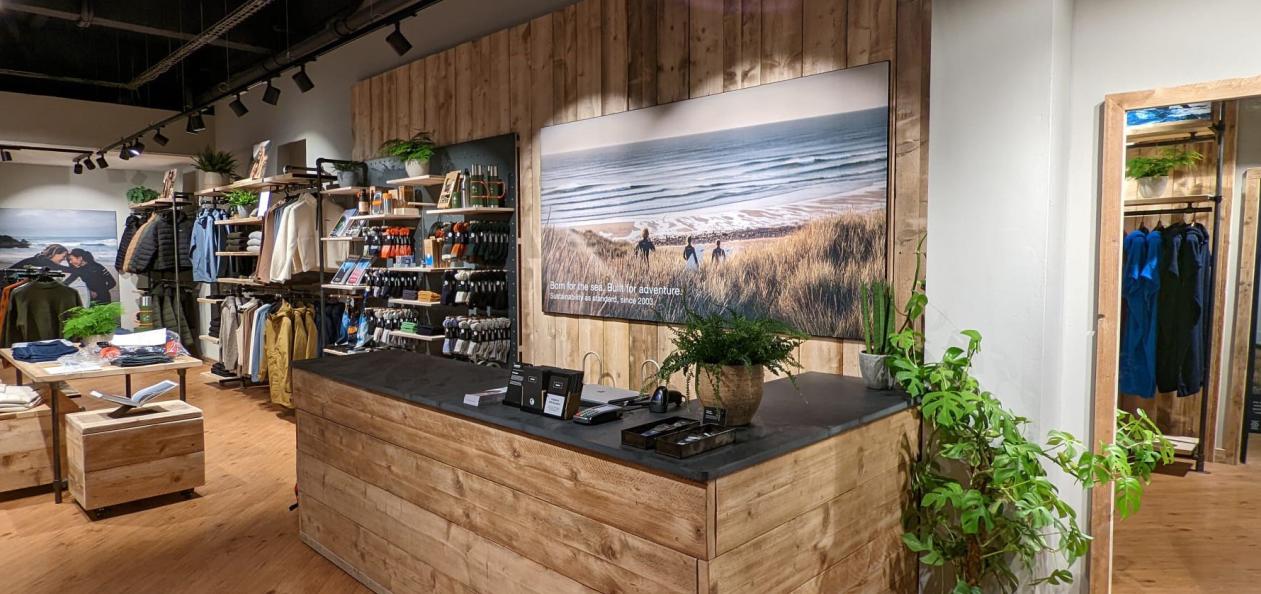
Retail environments also benefit from this approach - keeping fixtures in place while refreshing the graphic elements reduces both cost and waste.
Circularity isn’t a campaign.
It’s a habit.
6. Governance and Accountability That Actually Mean Something
Sustainability isn’t credible unless it’s governed.
Working within frameworks such as FSC certification and ISO 14001 means environmental considerations aren’t optional - they’re built into daily operations:
- responsible sourcing
- audited environmental management
- structured waste handling
- clear processes for continuous improvement
This is where sustainability becomes dependable: not a marketing headline, but an operating standard.
7. Sustainability Isn’t a Feature - It’s a Practice
When you stop treating sustainability as a “product” and start treating it as a set of everyday behaviours, you get work that is:
- more durable
- less wasteful
- easier to maintain
- safer to install
- more cost-efficient over its lifespan
- aligned with environmental expectations without the need for big claims
It becomes part of how projects run - from the first conversation about materials to the last step of removal and recycling.
That’s why sustainability in visual communications isn’t about a single product or an annual initiative.
It’s lived out in a hundred small decisions that quietly shape better outcomes.
And the clients who benefit most aren’t looking for a “green option.”
They’re looking for partners who work responsibly by default.
Heading
Read Next...
Rethinking Sustainability in Retail
Heading
Learn More...
What We Do